

Many small business owners hear the words bookkeeping and accounting and think they mean the same thing.
They are closely connected, but they are not the same job.
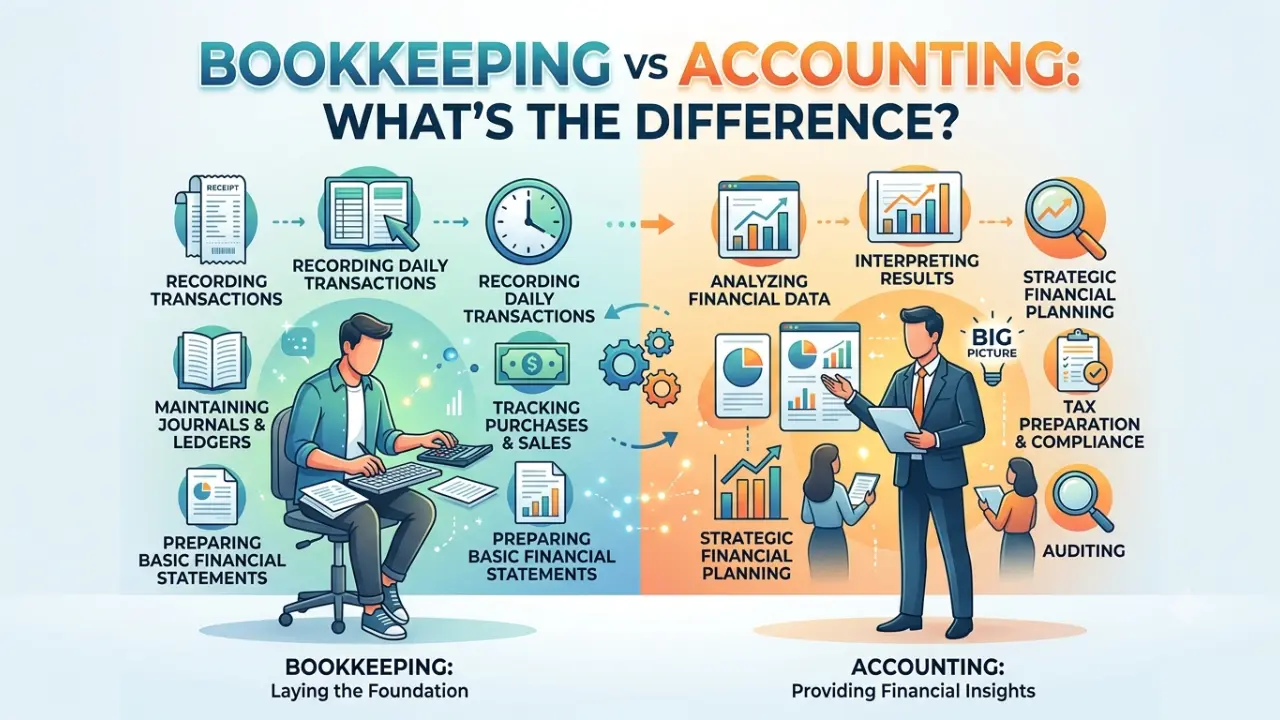
Bookkeeping mainly deals with recording and organizing financial transactions. Accounting goes a step further by reviewing those records and using the information to understand the financial health of a business.
Knowing the difference can help you understand what your business needs and when you may need professional help.
Bookkeeping and Accounting at a Glance
Here is the easiest way to understand the difference:
| Bookkeeping | Accounting |
|---|---|
| Records financial transactions | Reviews financial information |
| Tracks income and expenses | Analyzes business performance |
| Manages invoices and bills | Prepares and reviews financial statements |
| Reconciles bank accounts | Helps with financial planning |
| Keeps financial records organized | Helps with tax and financial decisions |
What Is Bookkeeping?
Bookkeeping is the process of recording a business’s financial transactions. Every time money comes into or goes out of your business, it needs to be recorded properly.
A bookkeeper may handle:
- Sales and income
- Business expenses
- Customer invoices
- Supplier bills
- Bank transactions
- Payments
- Accounts payable
- Accounts receivable
- Bank reconciliation
For example, if your business receives $2,000 from a customer, the transaction needs to be recorded.
If you then spend $500 on business supplies, that expense also needs to be recorded.
At the end of the month, you should have a clear record of what came in and what went out. The main goal is simple is Keep financial records accurate, complete, and organized.
What Is Accounting?
Accounting uses the financial information collected through bookkeeping to understand the bigger picture.
An accountant may review your records to answer questions such as:
- Is the business making a profit?
- Where is the business spending too much?
- How is cash flow looking?
- What do the financial statements show?
- What financial decisions should the business consider?
Accounting can also involve tax planning, financial analysis, reporting, and business advice.
So, while bookkeeping focuses on keeping the records right, accounting focuses more on understanding and using those records.
Imagine a small shop. During one month, the shop makes $10,000 in sales and spends $7,000 on business expenses.
The bookkeeper
The bookkeeper records:
- $10,000 sales
- $7,000 expenses
- Customer payments
- Supplier payments
- Bank transactions
Everything is entered and organized properly.
The accountant
The accountant can then use those records to look at the business’s financial position.
They may determine that the business made $3,000 before other applicable costs or adjustments and review what is affecting its performance.
They can also help the owner understand the financial reports and plan for future decisions.
What Tasks Does a Bookkeeper Handle?
A bookkeeper usually works with the day-to-day financial records of a business.
Recording Transactions
Income, expenses, purchases, and payments are recorded and categorized.
Managing Invoices
Customer invoices can be created, tracked, and marked as paid when payments are received.
Tracking Bills
Bills from suppliers and service providers can be recorded and monitored.
Bank Reconciliation
Bank statements are compared with business records to find missing or incorrect transactions.
Maintaining Financial Records
The bookkeeper keeps the company’s financial information organized and up to date.
What Tasks Does an Accountant Handle?
Accounting usually involves reviewing financial information and helping the business understand it.
Common accounting tasks include:
Financial Analysis
An accountant can review financial information to understand how the business is performing.
Financial Statements
Accountants may prepare or review statements such as:
- Profit and Loss Statement
- Balance Sheet
- Cash Flow Statement
Tax Support
Accountants can help with tax-related work and make sure financial information is properly prepared for tax purposes.
Financial Planning
They may help business owners plan budgets, manage costs, and make financial decisions.
Business Advice
Accounting information can help owners decide when to hire employees, invest in equipment, reduce expenses, or expand the business.